

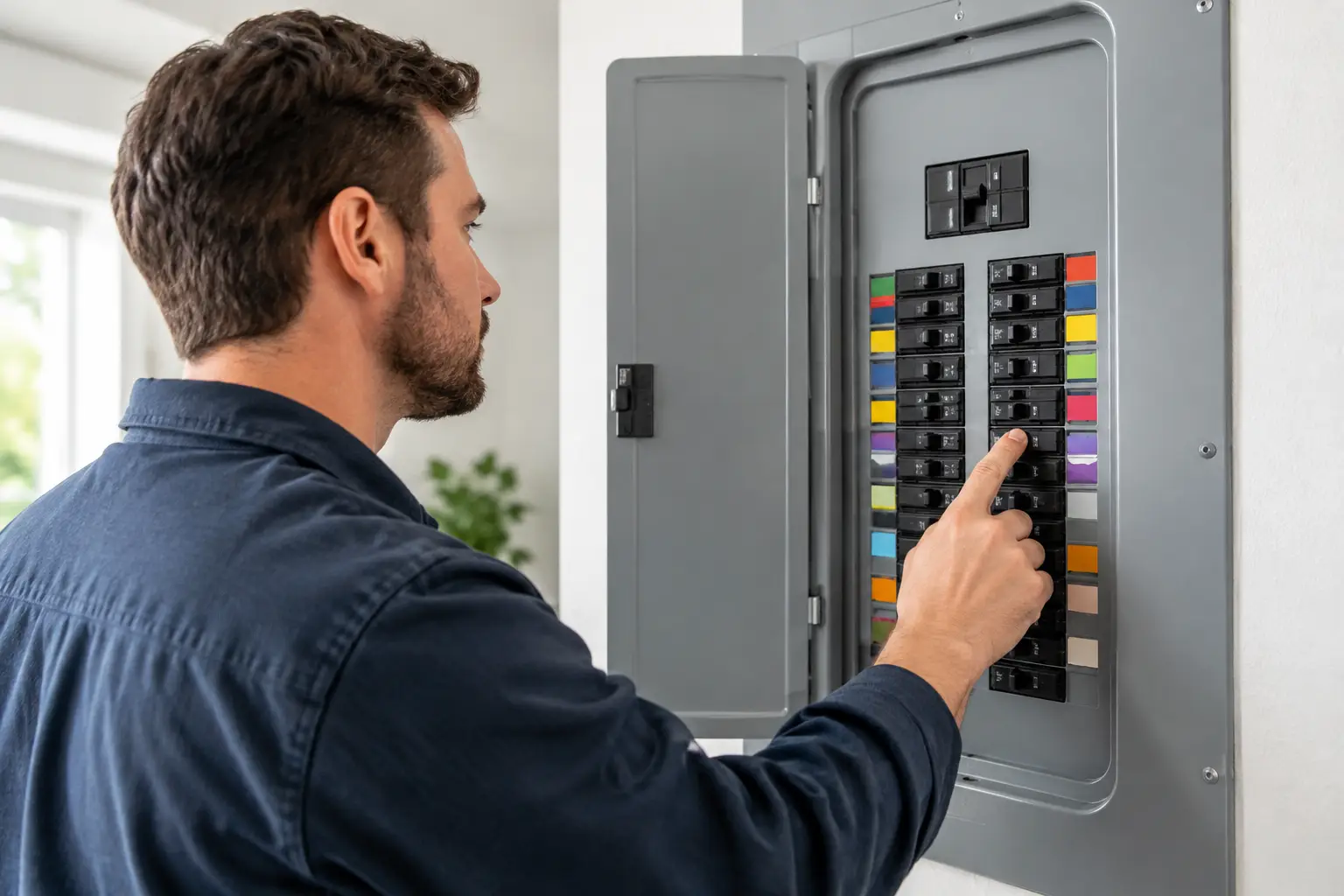
A tripped breaker is inconvenient. A panel label that says “lights” or “upstairs” can make it worse, especially when you are trying to reset power safely or shut off one circuit before a small repair. Accurate panel circuit labeling turns that confusing metal box into a practical map of your home.
You do not need to be an electrician to improve a messy or incomplete circuit directory. You do need patience, a reliable way to communicate with someone in the house, and a clear line between a safe mapping project and electrical work that requires a professional. Done carefully, labeling your panel can save time during outages, make routine troubleshooting less stressful, and help prevent someone from working on a circuit that is still energized.
Why panel circuit labeling matters
Your electrical panel distributes power through individual breakers. Each breaker controls a circuit, and each circuit may serve a room, several outlets, lights, appliances, or a combination of these. The directory inside the panel door should tell you what each breaker controls.
In many homes, that directory is incomplete from the day the home was built. Renovations, added outlets, replacement panels, and basement finishing projects can make old labels inaccurate. A breaker marked “bedroom” may also feed a hallway light. A label marked “garage” may power the garage door opener, exterior outlets, and a freezer.
That uncertainty creates real problems. You may shut off more of the house than necessary, reset the wrong breaker after an overload, or assume power is off when it is not. Clear labels support safer decisions, but they do not replace testing. Before touching wires, replacing an outlet, or opening an electrical box, always verify that power is off with an appropriate tester. If you are not comfortable doing that, call a licensed electrician.
What to gather before you start
This project goes best when you can work without rushing. Plan to map circuits during daylight hours, when turning off lights temporarily will not create a hazard. Ask another adult or responsible older teen to help if possible. One person can operate breakers while the other checks outlets and fixtures.
Have a flashlight, a phone for notes and photos, a pen, and durable labels or a fine-tip permanent marker. A plug-in lamp, phone charger, or outlet tester can help confirm whether receptacles are energized. An outlet tester is useful for checking power status, but it is not a substitute for a voltage tester when you are doing electrical repair.
If your panel is rusty, hot, buzzing, smells burned, has water damage, or shows signs of melted plastic, stop before beginning. Those are reasons to call an electrician. Do not remove the panel cover, reach behind the breaker area, or touch any exposed wiring. Circuit mapping only requires operating the breaker handles and reading the existing directory.
How to map and label your circuits
Start by taking a photo of the current panel directory, even if it is wrong. It gives you a backup record and may reveal useful clues from prior owners or electricians.
1. Set up a simple room-by-room check
Walk through the house first and note everything you want to identify: ceiling lights, wall switches, fixed appliances, smoke alarms, garage equipment, outdoor outlets, bathrooms, bedrooms, kitchen outlets, and HVAC-related equipment. You do not need a perfect inventory, but you do want to avoid missing less obvious loads.
Pay special attention to appliances that may be on dedicated circuits. Electric ranges, dryers, water heaters, air conditioners, sump pumps, dishwashers, disposals, furnaces, and microwaves often have their own breakers. Never casually switch off equipment that supports a medical need, an aquarium, a refrigerator full of food, or a home office without planning for the interruption.
2. Turn off one breaker at a time
At the panel, switch off one branch breaker. Do not turn off the main breaker for this project unless you have a separate, specific reason and understand its effect. The main breaker shuts down power to the whole home, but service conductors feeding the panel can still remain energized. Related: When Should Wiring Be Replaced in Your Home?
Have your helper check the planned locations. Turn on lights, try switches, and plug a lamp or tester into outlets. Check both halves of split receptacles where applicable, and test GFCI-protected outlets carefully. A bathroom, kitchen, garage, basement, or exterior outlet may be tied to a GFCI outlet elsewhere. If several outlets are off, note every location rather than labeling only the most obvious room.
For a one-person method, plug lamps into selected outlets and leave visible lights switched on. Then shut off a breaker, walk through the house, and record what went dark. This takes longer, but it is safer than guessing.
3. Write specific labels, not broad guesses
A good label answers the question: what will lose power if I switch off this breaker? “Kitchen counter outlets, dining outlet, pantry light” is much more useful than “kitchen.” “Primary bedroom outlets and ceiling fan” is better than “bedrooms.”
Keep labels short enough to read quickly. If a circuit serves multiple areas, list the most important locations first. For example: “Garage outlets, exterior front/rear” or “Upstairs bath GFCI, hall outlet.” If the circuit has a dedicated appliance, state that clearly: “Dishwasher only” or “Basement sump pump.”
Avoid labeling a breaker based solely on where you found it in the panel. Breaker position does not reliably correspond to a room. Also avoid writing “spare” unless you have confirmed that the breaker controls no connected load. An apparently unused breaker can still feed a hidden outlet, unfinished space, or old equipment. Related: How to Reset GFCI Outlets Without Guessing
4. Restore power and confirm your notes
Turn each breaker fully back on after testing it. Breakers should move firmly into the ON position. If a breaker trips immediately, will not reset, feels hot, or repeatedly shuts off during ordinary use, do not force it. Leave it off if necessary and arrange for professional service. Related: Home Electrical Panel Labeling Guide for Safer Fixes
Once the circuit is back on, quickly confirm that the lights and outlets you recorded have power again. This extra check catches errors caused by a switched-off lamp, a dead bulb, or an outlet with a separate issue.
Special cases that can confuse homeowners
Some circuits do not behave the way you expect. Multiwire branch circuits may involve two breakers that share a neutral conductor. These should have a tied handle or common disconnect, and they are not a DIY modification project. If you see two breakers linked together, label both based on what they serve and do not separate them.
A 240-volt appliance circuit usually uses a double-pole breaker that spans two panel slots. Label it as one circuit, such as “Electric dryer” or “Air conditioner.” Never replace or rearrange breakers to make labels look neater.
GFCI and AFCI breakers may have test buttons and can protect more than one location. If a test or reset situation is unclear, use the manufacturer information on the panel label or ask an electrician. Smoke alarms also deserve extra care. They are often interconnected and may be on a lighting circuit, but their behavior can vary by home and local code.
Keep the directory useful after the project
A circuit directory is not a one-time chore. Update it whenever you remodel, add an appliance, install an outlet, or have electrical work completed. Keep a photo of the finished directory on your phone so you can reference it during a power problem or share it with an electrician.
Use durable writing that will not smear or fade. If the panel has a printed card, fill it in neatly. If it does not, use a properly sized directory label inside the panel door rather than taping loose paper where it can fall or obscure required information.
Clear labels will not fix an overloaded circuit, a faulty breaker, or damaged wiring. They will, however, help you recognize patterns. If the same labeled circuit trips whenever the microwave and toaster run together, you have useful information for troubleshooting and for deciding when it is time to get professional help.
The best panel directory is not fancy. It is accurate enough that anyone in your household can find the right breaker without guesswork – and knows to stop and ask for help when the problem is more than a reset.
Check out more electrical solutions on Circuit Fixer homepage.
Frequently Asked Questions
What causes Panel Circuit Labeling Makes Home Repairs Safer?
This issue is usually caused by wiring problems, overloaded circuits, or faulty electrical components.
How to fix Panel Circuit Labeling Makes Home Repairs Safer?
Start by checking the breaker panel, then inspect outlets, switches, and wiring connections carefully.
Is Panel Circuit Labeling Makes Home Repairs Safer dangerous?
Yes, it can be dangerous if ignored. Electrical issues can lead to fire risks or equipment damage.
Circuit Fixer provides expert electrical troubleshooting guides for homeowners in the USA.
Learn more about us at Circuit Fixer.
Author: Circuit Fixer Team
Expert Insight
This guide was created by the Circuit Fixer Team, specializing in electrical troubleshooting and home wiring solutions in the USA.
Our team works with real-world electrical issues including GFCI outlets, circuit breakers, and wiring faults.
Reviewed by: Electrical Safety Specialist

