

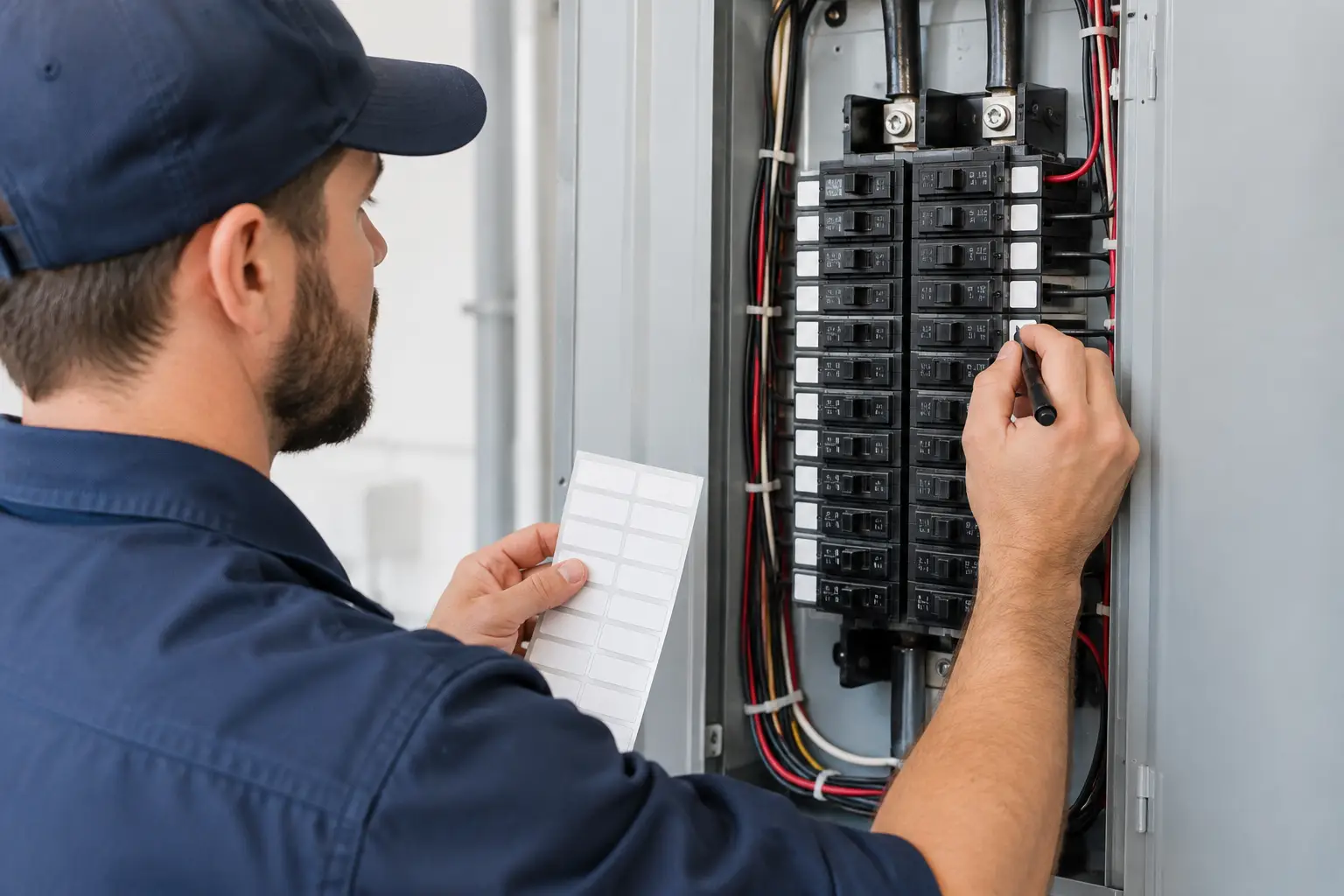
A breaker trips during dinner, and the panel directory says “lights” three different times. That is when a vague or outdated panel label stops being a small annoyance and becomes a real problem. Learning how to label electrical panel circuits gives you a practical map of your home, so you can reset the right breaker, shut off power for a small project, and give an electrician useful information if something goes wrong.
This is a homeowner-friendly job, but it is still electrical work. You will operate breaker handles only. Do not remove the panel cover, touch wiring, or work inside the panel. The service conductors and main lugs may remain energized even when the main breaker is off.
Why a clear panel directory matters
Your electrical panel is the traffic control center for your home. Each breaker protects a circuit, which may supply one room, part of a room, a major appliance, or a mix of outlets and lights. A good directory tells you what loses power when a specific breaker is switched off.
That information saves time when a breaker trips. It also helps you avoid accidentally shutting down a refrigerator, medical device, sump pump, home office, or internet equipment while working on another circuit. If you ever need to replace a light fixture or outlet, a clear label makes it easier to identify the correct breaker before you begin.
Do not assume the existing directory is accurate just because it is filled in. Homes are remodeled, additions are built, basement outlets get moved, and previous owners often leave behind labels that are too broad to be useful. “Upstairs” may have made sense to someone years ago, but it is not a dependable instruction during an urgent repair.
What you need before you start
Plan to spend an hour or two in a smaller home, and longer in a larger or remodeled house. The work goes faster with two people: one person at the panel and one person walking through the home. If you are working alone, a plug-in lamp, radio, or outlet tester can help confirm which outlets are off, though you will make more trips back and forth.
Gather a flashlight, painter’s tape or sticky notes, a pen, a phone or notepad, and a permanent marker. A small plug-in lamp is especially useful because it gives an obvious visual signal when an outlet loses power. You may also want a non-contact voltage tester for an extra check before future electrical work, but it is not a substitute for switching off the correct breaker and verifying power is off at the device.
Before testing, save computer work, pause laundry and dishwashers, and tell everyone in the house that the power will cycle on and off. Check for anything that should not be interrupted, such as a medical device, aquarium equipment, a sump pump during wet weather, or a refrigerator full of food. If an interruption could create a safety issue, postpone the project or get professional help.
How to label electrical panel circuits step by step
Start with the panel door open and the directory sheet visible. If it is torn, crowded, or written in pencil so faintly that you cannot read it, make a clean replacement directory. Take a photo of the old one first. Even imperfect notes can provide a useful starting point.
1. Number the breakers exactly as they appear
Look at the panel layout and assign each breaker a position number. Many panels already have numbered spaces, usually running down the left column and then down the right column. Follow the numbering printed by the panel manufacturer if it is present.
Write the breaker number in your notes before testing anything. This prevents a common mistake: identifying a circuit correctly, then writing its description beside the wrong breaker. Keep the panel layout in the same order as the breaker handles.
A double-pole breaker, used for equipment such as an electric range, dryer, water heater, or air conditioner, takes up two connected spaces. Treat it as one circuit and label both positions with the same appliance name. Do not separate the linked handles or try to test them as individual circuits.
2. Identify the major appliances first
Dedicated appliance circuits are usually the easiest to find. With the appliance turned off or idle when possible, switch off one breaker and see what stops working. Then turn the breaker back on and confirm the appliance returns to normal.
Use specific names such as “Kitchen refrigerator,” “Electric dryer,” “Garage door opener,” or “Basement sump pump.” If a breaker serves an HVAC unit, label it with the unit and location, such as “Upstairs air handler.” Specific wording is far more helpful than “appliances.” Related: How to Reset Garbage Disposal Power Safely
Some equipment may have more than one disconnect or breaker. An HVAC system, for example, can have separate indoor and outdoor components. If you are unsure what a breaker controls, leave it marked “Unknown – do not use” until you can investigate safely or have an electrician identify it.
3. Test room circuits one breaker at a time
For general-purpose circuits, turn on a few lights and plug your test lamp into an outlet in the area you are checking. Have your helper watch the rooms while you switch off one breaker. Never force a breaker that feels stuck or damaged. Related: How to Replace a Plug Fuse Safely at Home
When power goes off, record every item affected: lights, ceiling fans, outlets, smoke alarms, bathroom fans, garage outlets, exterior outlets, and nearby rooms. Then turn the breaker back on before moving to the next one. Testing one breaker at a time keeps your notes reliable.
Do not be surprised if a circuit crosses room boundaries. A breaker might feed the dining room lights, a hallway receptacle, and an outdoor porch light. That is common, especially in older homes. Label the circuit based on what it actually serves, not what you think it should serve.
4. Check outlets, not just lights
A light turning off does not prove you found every device on that circuit. Walk the room and test accessible outlets. In kitchens, bathrooms, garages, unfinished basements, and outdoor areas, pay close attention to receptacles because they may be protected by a GFCI outlet located somewhere else.
If several outlets are dead but the breaker is still on, look for a tripped GFCI receptacle and reset it only after unplugging the load that may have caused the trip. Note that relationship in your directory. For example: “Garage outlets – GFCI reset at garage workbench.” This small detail can prevent a frustrating search later.
Smoke and carbon monoxide alarms deserve extra care. Many are hardwired with battery backup and may be interconnected. Avoid repeatedly cycling these circuits if it causes nuisance alarms, and never leave an alarm circuit off after testing. If you cannot clearly determine what supplies the alarms, ask a qualified electrician.
5. Write labels that are short but precise
The best panel labels are readable at a glance. Use plain language, room names your household uses, and a detail that distinguishes similar circuits. “Kitchen counter outlets – east wall” is better than “Kitchen.” “Bedroom 2 outlets and lights” is better than “Bedrooms.”
When one breaker serves several areas, include the main areas separated by commas. If space is tight, use abbreviations you will understand later, such as “MBR” for primary bedroom, but avoid abbreviations that could confuse a guest, future owner, or electrician. Related: Breaker Reset vs Replacement: Which Is Safe?
Use a permanent marker or a typed, printed directory that is secured inside the panel door. Avoid labels placed directly on breaker handles. They can fall off, obscure the breaker position, and make the panel harder to use safely.
Special situations that need extra attention
Some circuits require more caution than others. A breaker with a TEST button may be an AFCI or GFCI breaker. Record its location and what it protects, but do not assume the TEST button is a complete circuit-identification tool. You still need to verify which lights and outlets lose power.
If two breakers must be switched off to make one 240-volt appliance stop, or if you find unusual shared circuits, stop guessing. Older homes can contain multiwire branch circuits or wiring changes that are not obvious from the panel door. A licensed electrician can identify these safely and correct labeling or protection issues if needed.
Call an electrician instead of continuing if you notice heat, burning odor, corrosion, moisture, buzzing, scorch marks, loose breakers, repeated trips, or breakers that will not reset. Labeling is not a repair method. A breaker that trips repeatedly is telling you there may be an overload, a faulty appliance, or a wiring problem worth investigating.
Keep the directory useful
Take a clear photo of the finished directory and save it where you can find it quickly. Update the panel label whenever you remodel, add a major appliance, install an EV charger, finish a basement, or change how a room is used. A circuit map is only helpful if it reflects the house you live in now.
A carefully labeled panel gives you calm, not just convenience. The next time an outlet goes dead or a breaker trips, you will know where to start – and you will know when the problem is beyond a safe homeowner fix.
Visit electrical guides for more step-by-step guides.
Frequently Asked Questions
What causes How to Label Electrical Panel Circuits Safely?
This issue is usually caused by wiring problems, overloaded circuits, or faulty electrical components.
How to fix How to Label Electrical Panel Circuits Safely?
Start by checking the breaker panel, then inspect outlets, switches, and wiring connections carefully.
Is How to Label Electrical Panel Circuits Safely dangerous?
Yes, it can be dangerous if ignored. Electrical issues can lead to fire risks or equipment damage.
Circuit Fixer provides expert electrical troubleshooting guides for homeowners in the USA.
Learn more about us at Circuit Fixer.
Author: Circuit Fixer Team
Expert Insight
This guide was created by the Circuit Fixer Team, specializing in electrical troubleshooting and home wiring solutions in the USA.
Our team works with real-world electrical issues including GFCI outlets, circuit breakers, and wiring faults.
Reviewed by: Electrical Safety Specialist

