

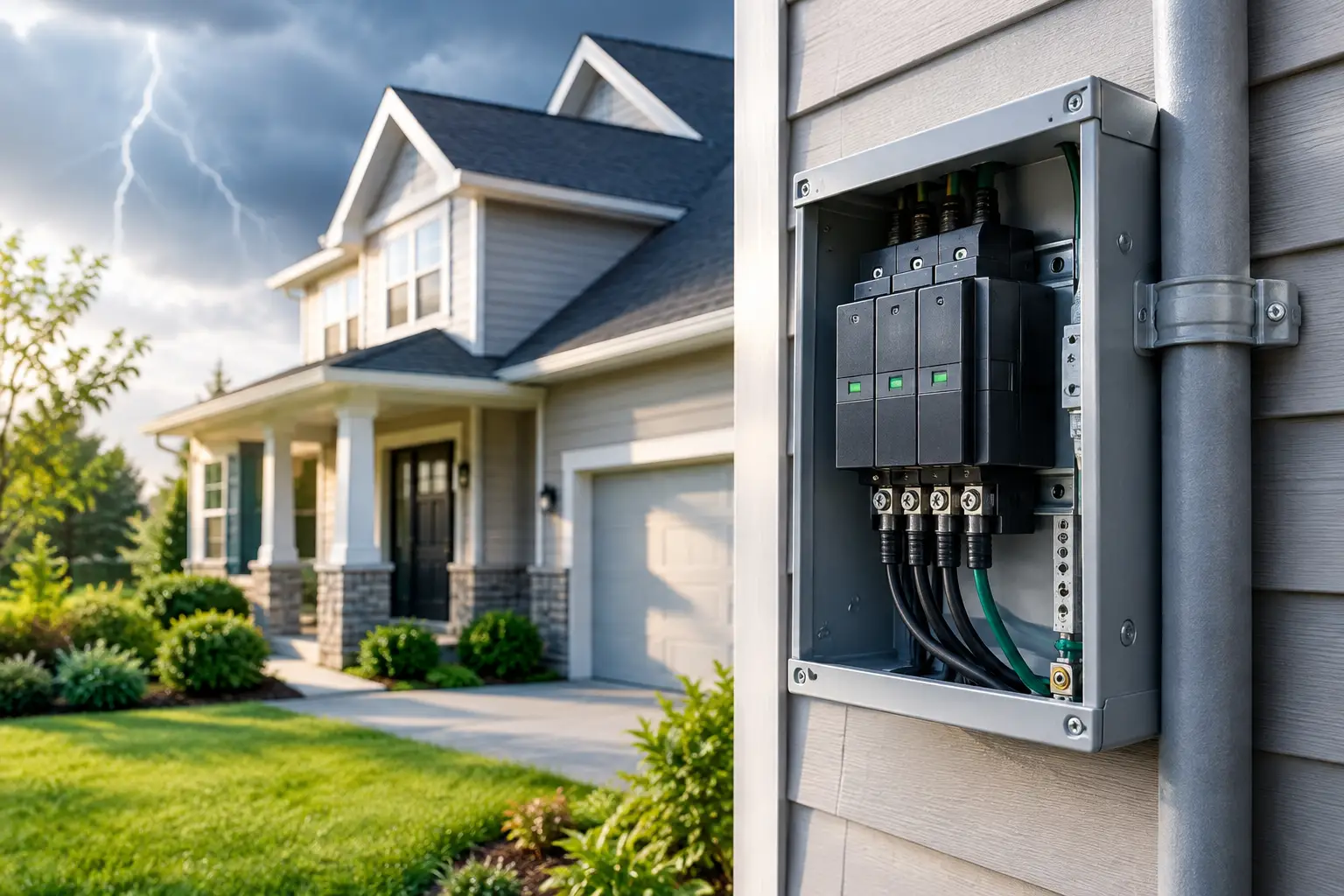
A refrigerator control board can fail after a storm even when the lights never go out. So can a garage-door opener, Wi-Fi router, HVAC thermostat, or the electronics inside a newer washing machine. A whole house surge protection guide starts with that reality: damaging electrical spikes are often brief, invisible, and capable of reaching nearly every circuit in the home.
A whole-house surge protective device, commonly called an SPD, is installed at or near your main electrical panel. It is designed to redirect excess voltage away from your home’s wiring when a surge occurs. It does not replace good wiring, grounding, or point-of-use surge strips, but it creates a valuable first line of defense for the systems you rely on every day. Related: How to Replace Smoke Detector Battery Safely
What Whole-House Surge Protection Does
Your home normally receives power at about 120 volts on standard circuits and 240 volts for large equipment such as central air conditioning, an electric range, or a dryer. A surge is a sudden increase in voltage above its normal level. It may last only a fraction of a second, but that can be long enough to damage delicate electronic components.
Lightning is the surge source most homeowners recognize, but it is not the only one. Utility switching, power restoration after an outage, downed lines, and large motors turning on and off can all create voltage spikes. Even equipment inside the home can contribute. Your air conditioner, well pump, refrigerator, and power tools place changing demands on the electrical system.
A whole-house SPD monitors the incoming electrical supply. When voltage rises beyond a safe threshold, the device provides a path for the excess energy to move toward the grounding system instead of continuing through your circuits. It reacts quickly, but it is not a force field. A direct lightning strike or a severely compromised electrical system can still cause damage.
Why a Panel-Level Device Is Worth Considering
Modern homes contain far more electronics than homes built a few decades ago. Many appliances now use circuit boards, touch controls, sensors, and variable-speed motors. Replacing a failed board can cost far more than homeowners expect, even when the appliance itself still looks fine.
Whole-house protection is especially useful for equipment that cannot reasonably plug into a surge strip. That includes hardwired HVAC systems, water heaters, ranges, dishwashers, garage-door openers, smoke alarm circuits, and built-in lighting controls. It also protects the wiring that feeds ordinary outlets throughout the house.
Still, panel protection and plug-in protection serve different jobs. A panel-mounted SPD handles larger surges entering the home and reduces the energy that reaches branch circuits. A quality surge strip or plug-in protector adds another layer for sensitive equipment such as televisions, computers, gaming systems, and networking gear. Using both is usually smarter than relying on one device alone.
Choosing the Right Whole-House Surge Protector
The model with the biggest number on the package is not automatically the best choice. The correct device depends on your electrical panel, local code requirements, the equipment you want to protect, and whether your home has a sound grounding system.
Start by looking for a device listed to UL 1449, the key safety standard for surge protective devices. Avoid unlisted products and vague claims that do not provide electrical ratings. A listed device has been tested for the job it is intended to perform.
Here are the specifications homeowners should recognize when comparing options:
- Type 1 or Type 2: Type 1 devices can be installed on the utility side or load side of the service disconnect, depending on the product and installation rules. Type 2 devices are installed on the load side, typically at the main panel. For many homes, a Type 2 SPD installed at the main panel is a common solution.
- Voltage protection rating (VPR): This indicates how much voltage may remain after the device responds to a standardized surge. In general, a lower VPR means less let-through voltage, though it should be evaluated alongside the device’s other ratings.
- Surge current capacity: Often shown in kiloamps, this describes how much surge current the unit can handle. Higher capacity can be useful in areas with frequent storms or unstable utility power, but capacity alone does not determine quality.
- Visual status indicator: Choose a unit with clear lights or another easy-to-check status signal. Surge devices wear down over time, and you need a simple way to know whether protection is still active.
Some units are designed as a breaker-mounted device for a specific compatible panel. Others mount beside or inside the panel and connect through a dedicated breaker. Panel compatibility matters. A device that fits physically is not necessarily approved for use in your panel.
Do Not Skip the Grounding Check
Surge protection depends on an effective grounding and bonding system. Grounding provides a controlled path for unwanted electrical energy, while bonding connects metal parts of the electrical system so they remain at the same electrical potential. If that system is missing, damaged, or outdated, an SPD cannot perform as intended.
Warning signs worth investigating include two-prong outlets, an old fuse box, visible corrosion at the panel, repeated breaker trips, flickering lights, or a home with electrical work of uncertain quality. These signs do not prove that the grounding system is defective, but they are good reasons to have the electrical service evaluated before adding protection.
This is also where homeowners should be realistic about DIY limits. You can safely identify your panel brand, note open breaker spaces, photograph the panel with the cover closed, and read the device requirements. Removing a panel cover, working near service conductors, or installing an SPD involves exposure to energized components. The main breaker does not always de-energize every part of the panel.
For that reason, installation is a job best handled by a qualified electrician. It is usually a straightforward service call, especially when the panel is modern and has space available. The electrician can confirm compatibility, use the correct breaker, keep conductor leads short, verify grounding and bonding, and meet local permit requirements.
A Practical Whole House Surge Protection Guide for Installation
Before scheduling installation, take a few minutes to prepare. Find the manufacturer and model number on your electrical panel label. Determine whether you have a main breaker panel, a meter-main combination, a subpanel, or a fuse panel. Then make a short list of the expensive or essential equipment in your home, such as HVAC equipment, a well pump, refrigerator, security system, solar equipment, or medical devices.
Ask the electrician whether the recommended SPD is listed for your panel and where it will be installed. In most cases, placement close to the main service equipment is preferred because longer connecting wires can reduce surge performance. If you have a detached garage, workshop, or outbuilding with its own panel, ask whether that panel needs protection too. A separate building with sensitive equipment may benefit from its own SPD.
If your home has solar panels, a standby generator, an EV charger, or a whole-home battery, mention it before the appointment. These systems add electrical paths and valuable electronics that may need a more tailored protection plan. Protection may be needed on AC circuits, communication lines, or other components depending on the equipment design.
Protect the Paths That Enter Your Home
Electricity is not the only route a surge can take. Cable, phone, ethernet, antenna, and other low-voltage lines can carry a surge into connected electronics. If your modem, router, or television connects to outside wiring, inspect the protection already provided by the service installer and consider additional listed protection where appropriate.
A simple example is a home office. A whole-house SPD can reduce incoming surges at the panel, but a power surge can also enter through a cable or network line. For expensive electronics, use a quality point-of-use protector designed for every connection you use, not just the power cord. Do not run cables through a protector unless that feature is appropriate for your system and will not reduce performance.
Maintenance and Signs Your Protection Needs Attention
Whole-house surge protectors are low-maintenance, not maintenance-free. Check the status indicator a few times a year and after a major storm, nearby lightning strike, utility event, or prolonged outage. Follow the manufacturer’s instructions for the meaning of each light or display. Related: Home Surge Protection Buying Guide for Safer Homes Related: 8 Safest Home Electrical Upgrades to Plan First
If the indicator shows the device is no longer protecting, arrange replacement promptly. Do not assume it will reset itself. Also call an electrician if you notice burning odors, heat at the panel, buzzing, discoloration, water intrusion, or breakers that trip repeatedly. Those are electrical safety concerns, not routine surge-protector maintenance.
Surge protection cannot guarantee that every electronic device will survive every event. What it can do is reduce a common and costly risk across the home. Start with a listed panel-level SPD, make sure your grounding is sound, and add point-of-use protection where sensitive electronics need an extra layer. That small amount of planning can make the next storm, outage, or utility disturbance much less stressful.
For more expert guides, visit electrical guides.
Frequently Asked Questions
What causes Whole House Surge Protection Guide for Homeowners?
This issue is usually caused by wiring problems, overloaded circuits, or faulty electrical components.
How to fix Whole House Surge Protection Guide for Homeowners?
Start by checking the breaker panel, then inspect outlets, switches, and wiring connections carefully.
Is Whole House Surge Protection Guide for Homeowners dangerous?
Yes, it can be dangerous if ignored. Electrical issues can lead to fire risks or equipment damage.
Circuit Fixer provides expert electrical troubleshooting guides for homeowners in the USA.
Learn more about us at Circuit Fixer.
Author: Circuit Fixer Team
Expert Insight
This guide was created by the Circuit Fixer Team, specializing in electrical troubleshooting and home wiring solutions in the USA.
Our team works with real-world electrical issues including GFCI outlets, circuit breakers, and wiring faults.
Reviewed by: Electrical Safety Specialist

